Overview
Tesamorelin is a synthetic analog of growth hormone-releasing hormone (GHRH), engineered for enhanced enzymatic stability compared to native GHRH. It retains the full 44-residue GHRH sequence and carries a trans-3-hexenoic acid group at the N-terminus, a modification that blocks cleavage by dipeptidyl peptidase-IV (DPP-IV). In the laboratory, tesamorelin is used as a tool compound for studying the GHRH receptor (GHRH-R), its Gαs/cAMP signaling cascade, and the biology of pituitary somatotroph cells. It has been examined in published in-vitro and animal research, with a supporting literature spanning receptor pharmacology, intracellular signaling, peptide chemistry and receptor distribution. All research use only.
Molecular Profile
| Parameter | Value |
|---|---|
| Full name | Trans-3-hexenoic acid-GHRH(1-44)-NH2 |
| Abbreviation | Tesamorelin |
| Molecular weight | 5,135.9 Da |
| Formula | C221H366N72O67S |
| PubChem CID | 16137828 |
| Sequence length | 44 amino acids |
| N-terminal modification | Trans-3-hexenoic acid |
| C-terminus | Amide |
| DPP-IV susceptibility | N-terminal Tyr-Ala cleavage site protected by the trans-3-hexenoyl group |
| Solubility | Water-soluble |
| Isoelectric point (pI) | ~8.2–8.5 (estimated from amino acid composition; basic due to Lys/Arg residues) |
| Primary hydrolysis products | N-terminal trans-3-hexenoyl fragment; internal chain fragments at Asp/Pro and Asn residues; DPP-IV cleavage prevented by N-terminal modification |
| Common HPLC impurities | Deletion sequences, oxidized Met variants, truncated fragments from incomplete chain elongation |
Section 1 — Mechanism of Action
GHRH-R Binding and G Protein Activation
Tesamorelin binds GHRH receptors, a 7-transmembrane Gαs-coupled GPCR on anterior pituitary somatotrophs. Receptor activation engages adenylyl cyclase, elevating intracellular cAMP, which activates PKA. PKA phosphorylates CREB and voltage-gated calcium channels (Mayo KE et al., Recent Prog Horm Res 1995, PMID 7740167; Mayo KE et al., Recent Prog Horm Res 2000, PMID 11036940).
Intracellular Cascade: ERK, JAK/STAT, Calcium
Beyond the primary Gαs/cAMP/PKA pathway, GHRH-R activation engages MAP kinase signaling including ERK1/2 phosphorylation, which modulates somatotroph proliferation and GH gene transcription, as well as JAK/STAT pathway activation linked to GH synthesis. Calcium influx through PKA-phosphorylated L-type channels triggers exocytosis of GH secretory granules in cultured somatotrophs.
Class B GPCR Structure
The GHRH receptor belongs to the secretin family (class B) of G protein-coupled receptors. Ligands of this family bind in two steps: the C-terminal region of the peptide is captured by the receptor's large N-terminal extracellular domain, and the N-terminal region of the peptide then engages the transmembrane core to trigger activation. Because the N-terminus of GHRH is essential for receptor activation, modifications at this end — such as the trans-3-hexenoyl group of tesamorelin — are chosen to protect against degradation without disrupting the activating contact.
Transcriptional Readouts
Downstream of PKA, phosphorylated CREB and the pituitary-specific transcription factor Pit-1 cooperate to drive GH gene transcription. In cultured pituitary cells, GH mRNA levels, CREB phosphorylation and reporter constructs driven by the GH promoter are common readouts of GHRH-R activation, complementing direct measurement of cAMP.
Half-Life Chemistry
The trans-3-hexenoic acid N-terminal modification confers resistance to DPP-IV cleavage — the primary native GHRH degradation pathway — without altering the receptor-binding sequence. Native GHRH is cleaved by DPP-IV between Ala2 and Asp3, producing an inactive GHRH(3-44) fragment; acylation of the N-terminal amine prevents the enzyme from recognizing this site.
Section 2 — Research Contexts
GHRH Receptor Pharmacology
Tesamorelin serves as a reference agonist for the GHRH receptor in radioligand competition binding, cAMP accumulation and reporter-gene assays. Because it contains the complete native sequence, it is a useful comparator when characterizing truncated or substituted analogs, allowing investigators to separate the contribution of the C-terminal 30–44 region from that of the minimal active GHRH(1-29) core.
Second-Messenger and Kinase Signaling
The compound is used to activate the Gαs/cAMP/PKA pathway in a receptor-specific manner and to study how this pathway interacts with ERK1/2, JAK/STAT and calcium signaling in somatotroph-derived cells. Time-resolved measurements of cAMP, PKA substrate phosphorylation and ERK activation help map the kinetics of each branch.
Somatotroph Cell Biology
Primary rat and mouse pituitary cell cultures contain somatotrophs alongside other pituitary cell types. Tesamorelin is used in these cultures to study GH gene transcription, secretory granule exocytosis and the interplay between stimulatory GHRH signaling and inhibitory somatostatin signaling at the level of the individual cell.
Receptor Desensitization and Trafficking
Like other GPCRs, the GHRH receptor undergoes phosphorylation, β-arrestin recruitment and internalization after sustained stimulation. Tesamorelin is used in cell systems expressing tagged receptors to follow internalization and recycling by imaging and to quantify the loss and return of cAMP responsiveness after repeated stimulation.
Structure–Activity Relationships of GHRH Analogs
The history of GHRH analog design is largely a history of protecting the peptide from enzymatic degradation while preserving the activating N-terminus. Tesamorelin (N-terminal acylation of the full-length sequence), sermorelin (the unmodified 1-29 fragment) and albumin-conjugating analogs represent three distinct design strategies, and side-by-side comparison of their stability and receptor activity in vitro is a common structure–activity comparison.
Extrapituitary GHRH Receptor Research
GHRH receptor expression has been documented outside the pituitary, including in immune cells and neural tissue (see Section 8). Tesamorelin provides a stable, receptor-specific agonist for studying GHRH-R signaling in these non-pituitary cell types.
Analytical Reference Standard Use
As a well-defined 44-residue peptide with a known N-terminal modification, tesamorelin is also used as a reference standard in HPLC and LC-MS method development, including the separation of deletion sequences, oxidized methionine variants and truncated fragments from the target peptide.
All applications for research use only.
Peer-reviewed research methods are available in the published academic literature. See linked citations below.
Section 3 — Product Specifications
Lyophilized powder, supplied for in-vitro laboratory research use only. Purity is assessed by HPLC, and identity by the method printed on the Certificate of Analysis; see the Certificate of Analysis published for this product for the testing laboratory and the measured values.
Section 4 — Frequently Asked Questions
Q: What is tesamorelin used for in research?
A: Tesamorelin is a synthetic GHRH analog used in laboratory research as a tool compound for studying GHRH receptor binding and the downstream Gαs/cAMP signaling pathway in pituitary-derived cell systems. It is supplied for in-vitro research use only.
Q: How does tesamorelin differ from other GHRH analogs?
A: Tesamorelin is full-length GHRH(1-44) with a trans-3-hexenoic acid N-terminal modification that protects it from cleavage by dipeptidyl peptidase-IV (DPP-IV), the principal degradation route for native GHRH. Many other analogs are shorter GHRH(1-29) fragments.
Q: How is Excalibur's tesamorelin analytically verified?
A: Purity is assessed by HPLC, and identity by the method printed on the Certificate of Analysis, by an independent third-party laboratory. The Certificate of Analysis is published for this product in our COA database, with the laboratory's name and lookup reference.
Q: What is the molecular weight of tesamorelin?
A: 5,135.9 Da (PubChem CID 16137828). Molecular formula: C221H366N72O67S.
Q: How should tesamorelin be stored in a research setting?
A: Lyophilized: 2–8 °C, protected from light and moisture, in a sealed vial, as listed on the product page. Allow vials to reach room temperature before opening to limit condensation, and avoid repeated freeze-thaw.
Q: Which receptor does tesamorelin act on?
A: The GHRH receptor (GHRH-R), a class B G protein-coupled receptor expressed on anterior pituitary somatotrophs that signals mainly through Gαs, adenylyl cyclase and cAMP.
Q: What comes in a vial of tesamorelin from Excalibur Peptides?
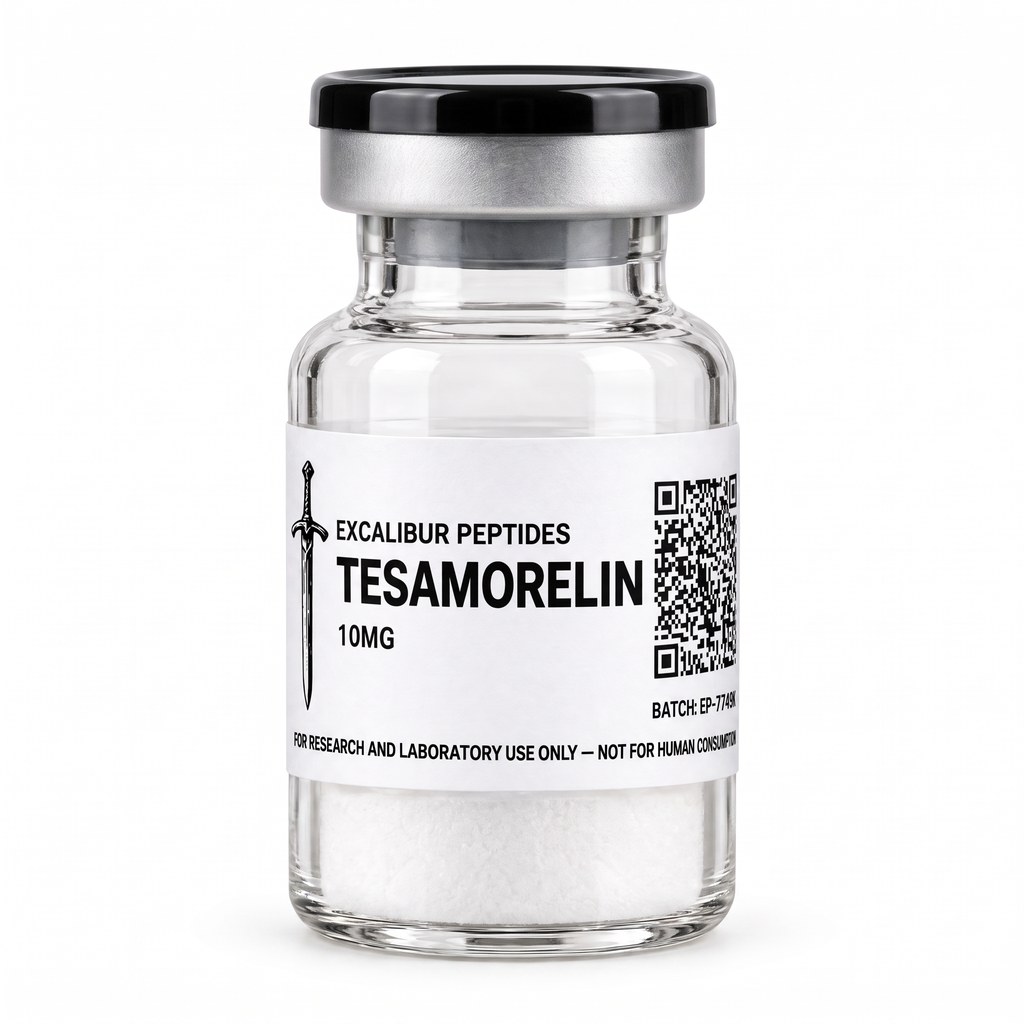
A: One sealed glass vial of lyophilized tesamorelin, 10 mg by label amount. The label carries the product name, size, a printed batch ID, a QR code and a research-use-only line.
Section 5 — Peptide Chemistry and Synthesis
Solid-Phase Peptide Synthesis
Peptides of this length are generally assembled by Fmoc solid-phase peptide synthesis (SPPS). Each coupling round consists of (1) Fmoc deprotection with piperidine; (2) carboxyl activation via HATU/DIC; (3) coupling to the free amine; and (4) capping of unreacted amine. The sequence is repeated for all 44 residues, with special handling for the trans-3-hexenoic acid N-terminal modification. Cleavage from the resin uses TFA-based cleavage cocktails (Merrifield RB, Adv Enzymol 1969, PMID 4307033; Behrendt R et al., J Pept Sci 2016, PMID 26785684).
Purification
In general peptide chemistry, preparative HPLC on C18 columns (acetonitrile/water gradients with TFA ion-pairing) separates the target peptide from deletion sequences, truncated chains and oxidized variants. For a peptide of this length, multiple chromatographic passes are typically required.
Lyophilization and Storage
The product page lists lyophilized tesamorelin for storage at 2–8 °C, sealed and protected from light and moisture; moisture ingress is the primary degradation risk for lyophilized peptides. UV exposure can oxidize susceptible residues, and repeated freeze-thaw degrades peptide integrity.
Quality Control
Analytical characterization of tesamorelin typically comprises HPLC, with purity reported as a peak-area percentage, and an identity method. LC-MS confirms identity against the calculated mass of 5,135.9 Da; for a peptide of this size, electrospray ionization produces a series of multiply charged ions that are deconvoluted to the neutral mass. FTIR confirms identity by matching the infrared spectrum to a reference. The Certificate of Analysis for this product names the testing laboratory, reports HPLC purity and the identity result, and is published in our COA database.
Section 6 — Comparative Pharmacology
| Compound | Class | Receptor | Structural Note |
|---|---|---|---|
| Tesamorelin | GHRH analog (full-length) | GHRH-R | 44 residues; N-terminal trans-3-hexenoyl group |
| Sermorelin | GHRH analog (1-29) | GHRH-R | Unmodified GHRH(1-29)-NH2 fragment |
| CJC-1295 (DAC) | GHRH analog (albumin-binding) | GHRH-R | Modified GHRH(1-29) with maleimide linker for albumin conjugation (PMID 15817669) |
| CJC-1295 no DAC | GHRH analog (1-29 modified) | GHRH-R | Modified GHRH(1-29) without albumin linker |
| Ipamorelin | GHS-R1a agonist | GHS-R1a | Pentapeptide Aib-His-D-2-Nal-D-Phe-Lys-NH2 (PMID 9849822) |
| GHRP-6 | GHS-R1a agonist | GHS-R1a | Hexapeptide His-D-Trp-Ala-Trp-D-Phe-Lys-NH2 |
| Hexarelin | GHS-R1a agonist | GHS-R1a | Hexapeptide with 2-methyl-D-Trp at position 2 |
| MK-677 (Ibutamoren) | GHS-R1a agonist | GHS-R1a | Non-peptide spiropiperidine small molecule |
| rGH (Somatropin) | Recombinant GH | GH receptor | 191-residue recombinant protein; acts downstream of GHRH-R |
Sermorelin vs Tesamorelin
Sermorelin (GHRH 1-29) shares the canonical GHRH-R / Gαs / cAMP / PKA mechanism with tesamorelin but represents a truncated 29-amino-acid fragment retaining only the N-terminal portion required for receptor activation. Because it lacks N-terminal protection, sermorelin is rapidly cleaved by DPP-IV. In vitro, the pair is useful for asking how much the C-terminal 30–44 region and the N-terminal acyl group each contribute to receptor affinity and enzymatic stability.
CJC-1295 (DAC) vs Tesamorelin
CJC-1295 with DAC (Drug Affinity Complex) carries a maleimide reactive group designed to form a covalent bond with cysteine-34 of serum albumin, an approach to half-life extension characterized in rat models and in vitro (PMID 15817669). Tesamorelin instead relies on N-terminal acylation for enzymatic protection and does not bind albumin covalently. The two therefore illustrate different chemical strategies — conjugation versus terminal modification — for stabilizing GHRH analogs.
GHS-R1a Class vs Tesamorelin
Ipamorelin, GHRP-6 and hexarelin act at the growth hormone secretagogue receptor (GHS-R1a) — the ghrelin receptor — which couples mainly to Gαq/11, phospholipase C and intracellular calcium rather than to Gαs and cAMP. Because GHRH-R and GHS-R1a use different second-messenger systems, they are studied together in research on receptor cross-talk at the somatotroph. Ipamorelin has been characterized in animal models as a selective member of the GHS-R1a class (PMID 9849822). Tesamorelin is the appropriate probe when the research question concerns GHRH-R biology specifically.
MK-677 (Ibutamoren) vs Tesamorelin
MK-677 is a non-peptide small molecule that acts at GHS-R1a rather than at the GHRH receptor. Its chemistry, solubility and analytical handling are those of an organic small molecule, whereas tesamorelin is a 44-residue peptide characterized by peptide-specific methods such as HPLC and electrospray LC-MS. In receptor pharmacology the two compounds address different receptors and are not interchangeable.
rGH (Somatropin) vs Tesamorelin
Recombinant human growth hormone (somatropin, rGH) is the 191-residue GH protein itself. It acts directly at the GH receptor and bypasses the GHRH receptor entirely, whereas tesamorelin acts upstream at GHRH-R on somatotrophs. In cell-based research, rGH is used to study GH receptor signaling (JAK2/STAT5) in target cells, while tesamorelin is used to study the pituitary receptor that controls GH synthesis and secretion.
Section 7 — Related Research Compounds
- GHRP-6 — hexapeptide agonist of the ghrelin receptor (GHS-R1a), a different receptor of the GH axis
- TB-500 — synthetic peptide related to Thymosin Beta-4
- GHK-Cu — copper-binding tripeptide
Section 8 — Receptor Biology and Endocrinology Context
Extrapituitary GHRH-R Distribution
GHRH receptor expression extends well beyond the classical pituitary somatotroph compartment, with functional receptors documented in immune, central nervous and peripheral tissues — a distribution that informs research into non-endocrine GHRH-R signaling. Rat mononuclear leukocytes from spleen and thymus express specific, saturable, high-affinity GHRH-R binding sites with affinity comparable to pituitary tissue (~3.5 nM in thymus, ~2.5 nM in spleen) (PMID 1714793). Splenic T and B cells and leukocytes from primary and secondary immune tissues also express GHRH-R, with expression levels that differ between young and older animals (PMID 23770714). Peripheral GHRH-R has also been reported in pancreas, kidney, heart and reproductive tissues, which makes tesamorelin a relevant probe for receptor-mediated signaling outside the pituitary.
Somatostatin and Axis Tone
GH secretion at the somatotroph is governed by the balance between GHRH (stimulatory) and somatostatin (inhibitory) inputs. Somatostatin acts through Gαi-coupled receptors (SSTR2 and SSTR5 on somatotrophs) that inhibit adenylyl cyclase and open potassium channels, directly opposing the GHRH-R/Gαs signal. In pituitary cell cultures, co-application of somatostatin receptor agonists is used to study how inhibitory tone shapes the cAMP and secretory response to GHRH-R activation. Accounting for this regulatory layer is important when interpreting any in-vitro GHRH-R readout from mixed pituitary cell populations.
GHRH-R Desensitization
Repeated or high-frequency GHRH-R stimulation induces receptor desensitization through a series of GPCR-typical mechanisms: GRK-mediated receptor phosphorylation, β-arrestin recruitment, receptor internalization into endosomes, Gαs uncoupling and downregulation of cAMP responsiveness. Pulsatile versus continuous stimulation is a variable in this kind of work. In cell systems, desensitization is quantified by comparing cAMP responses to a second stimulation after defined washout intervals.
Ghrelin Axis Cross-Talk
GHRH-R and GHS-R1a (the ghrelin receptor) signaling converge at the pituitary somatotroph. Published work has proposed functional interaction between the two receptor systems, potentially via receptor heterodimerization or shared downstream effector pools, to explain the greater-than-additive signaling observed when both receptors are activated together in experimental systems. For in-vitro work, this cross-talk means that the ghrelin-receptor status of the cell system — endogenous expression, constitutive activity and the presence of ghrelin in serum-containing media — should be documented when interpreting GHRH-R responses.
Section 9 — In-Vitro Methodology Considerations
Cell Systems
Two main types of cell system are used. Heterologous cells (for example HEK293 or CHO) stably or transiently expressing the human GHRH receptor isolate the receptor for binding and cAMP assays, while primary pituitary cell cultures preserve native somatotrophs and their regulatory inputs. Receptor expression in heterologous systems should be confirmed by qPCR, western blot or binding before functional work begins, and parental cells lacking the receptor serve as negative controls.
Assay Readouts
cAMP accumulation is typically measured by HTRF, AlphaScreen or luminescent biosensor assays in the presence of a phosphodiesterase inhibitor. Radioligand competition binding with labeled GHRH analogs quantifies affinity, and CRE-driven luciferase reporters provide a transcriptional readout. GH released into culture medium from primary pituitary cells is quantified by immunoassay. Concentration–response curves spanning several log units, run in replicate, allow calculation of EC50 values for comparison between analogs.
Peptide Handling in Assays
Large peptides such as tesamorelin adsorb to plastic and glass surfaces at low concentrations. Low-binding tubes and plates, and the inclusion of a carrier protein such as bovine serum albumin in assay buffers, reduce losses. Repeated freeze-thaw of stock material is avoided, and because methionine oxidation reduces activity, material is protected from light and air.
Common Research Pitfalls
The most frequent methodological errors in GHRH-R research concern reagent integrity and cell-system characterization. First, oxidized or partially degraded peptide lowers apparent potency; confirming identity (by LC-MS or FTIR) before critical experiments avoids misattributing a weak response to the receptor. Second, receptor expression drifts with passage number in transfected lines, so expression should be rechecked periodically. Third, serum components, including endogenous peptides and proteases, can interfere with readouts, which is why serum-free stimulation buffers are generally preferred. Finally, mixed primary pituitary cultures contain inhibitory somatostatin signaling that can mask GHRH-R responses unless it is controlled or measured.
Section 10 — Citations
All references peer-reviewed; PubMed IDs provided for verification. For research and laboratory use only.
- Mayo KE et al. Growth hormone-releasing hormone: synthesis and signaling. Recent Prog Horm Res 1995. PMID 7740167
- Mayo KE et al. Regulation of the pituitary somatotroph cell by GHRH and its receptor. Recent Prog Horm Res 2000. PMID 11036940
- Jetté L et al. hGRF1-29-albumin bioconjugates activate the GRF receptor on the anterior pituitary in rats: identification of CJC-1295 as a long-lasting GRF analog. Endocrinology 2005. PMID 15817669
- Raun K et al. Ipamorelin, the first selective growth hormone secretagogue. Eur J Endocrinol 1998. PMID 9849822
- Merrifield RB. Solid-phase peptide synthesis. Adv Enzymol 1969. PMID 4307033
- Behrendt R et al. Advances in Fmoc solid-phase peptide synthesis. J Pept Sci 2016. PMID 26785684
- Guarcello V et al. Growth hormone releasing hormone receptors on thymocytes and splenocytes from rats. Cell Immunol 1991. PMID 1714793
- Weigent DA. Expression of lymphocyte-derived growth hormone (GH) and GH-releasing hormone receptors in aging rats. Cell Immunol 2013. PMID 23770714
- PubChem CID 16137828 — Tesamorelin molecular reference.
Related research compounds: TB-500 · GHK-Cu · GHRP-6
WARNING: For research and laboratory use only. Not for human consumption. Not approved by the FDA for human use.
Section 11 — Research Outlook
Tesamorelin occupies a distinct position among GHRH-class research compounds: it preserves the complete native GHRH sequence while adding a single, well-defined N-terminal modification that protects against DPP-IV. This makes it a clean tool for asking questions about the full-length ligand at the GHRH receptor — questions that truncated analogs cannot address. Its supporting literature spans receptor pharmacology, intracellular signaling, peptide chemistry and extrapituitary receptor distribution, giving investigators a documented foundation for in-vitro study design.
The compound is also a useful platform for comparative pharmacology research. Pairing tesamorelin with GHS-R1a agonists such as GHRP-6 in cell systems enables study of GHRH-R / GHS-R1a cross-talk at the somatotroph, while comparison with shorter GHRH(1-29) analogs isolates the contribution of the C-terminal region and the N-terminal acyl group. As understanding of GHRH-R biology continues to expand into immune, neural and peripheral tissue contexts, tesamorelin remains a well-characterized pharmacological probe of GHRH-R signaling for in-vitro research.
WARNING: For research and laboratory use only. Not for human consumption. Not approved by the FDA for human use.