Overview
GHK-Cu (glycyl-L-histidyl-L-lysine copper²⁺) is a naturally occurring tripeptide-copper complex first isolated from human plasma in the early 1970s and subsequently characterized across more than five decades of peer-reviewed research. The molecule occupies an unusual position in peptide chemistry: it is simultaneously an endogenous plasma constituent, a high-affinity copper chelator and a copper carrier that interacts with cellular copper-handling pathways. In research contexts, GHK-Cu has been examined in published in-vitro and animal research on copper coordination chemistry, delivery of copper to copper-dependent enzymes, extracellular-matrix protein synthesis in cultured fibroblasts, NF-κB pathway signaling and gene expression (Pickart et al., Biomed Res Int 2015; PMID 26236730). Much of this work was carried out by L. Pickart and colleagues. All research use only.
Molecular Profile
| Property | Value |
|---|---|
| Full name | Glycyl-L-Histidyl-L-Lysine Copper(II) |
| Abbreviation | GHK-Cu |
| Molecular formula | C₁₄H₂₂CuN₆O₄ |
| Molecular weight | 402.9 Da |
| CAS | 49557-75-7 |
| Structure | Tripeptide; square planar copper complex |
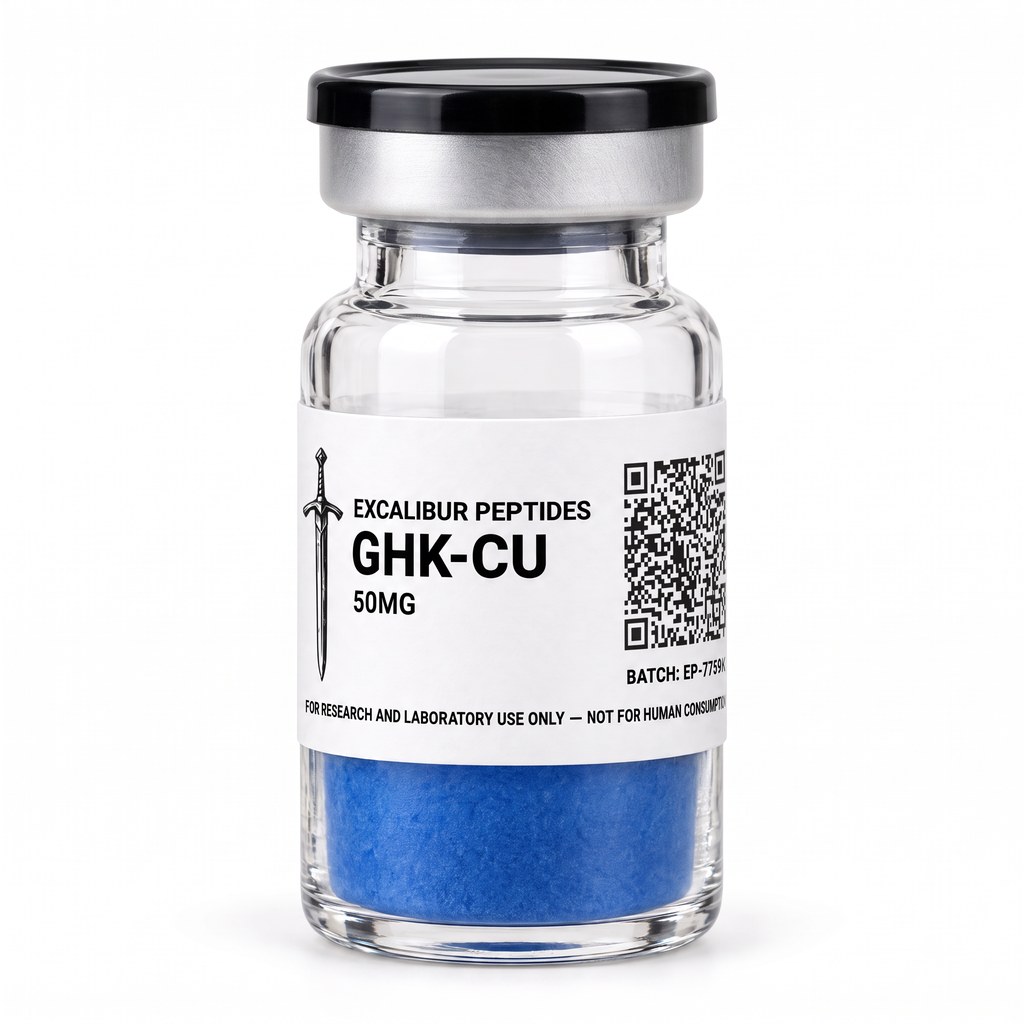
| Appearance | Blue lyophilized powder (color from the Cu²⁺ complex) |
| Solubility | Freely soluble in water |
| Copper coordination | Square planar Cu²⁺ via Gly α-amine, His imidazole N, deprotonated backbone amide N |
| Binding affinity for Cu²⁺ | Log K ≈ 16 (high-affinity chelator) |
Section 1 — Foundational Discovery and Copper Chelation Chemistry
The human tripeptide GHK was first isolated from human plasma albumin fractions in research dating to the early 1970s, identified by Loren Pickart as a factor that altered the behavior of hepatocytes in primary culture (Pickart & Thaler, FEBS Lett 1979; PMID 556547). Subsequent biochemical characterization showed that the copper-chelated complex, rather than the free tripeptide, is the species relevant to most of the activity described in plasma and in research contexts. The chelation geometry is square planar around the Cu²⁺ ion, with coordination provided by the terminal α-amine of glycine, the imidazole nitrogen of histidine and a deprotonated backbone amide nitrogen — a high-affinity arrangement specific to this tripeptide sequence. The fourth coordination position is typically occupied by water or by the carboxylate side chain of an external ligand. This structural specificity gives GHK-Cu both kinetic stability in aqueous media and the ability to participate in controlled copper exchange with cellular acceptor proteins.
Copper itself is a redox-active transition metal essential for the catalytic activity of multiple human enzymes, but free Cu²⁺ catalyzes Fenton-type generation of reactive oxygen species and damages biomolecules indiscriminately. Cellular copper is therefore handled by chaperone proteins and high-affinity chelators that prevent free copper exposure while enabling targeted delivery to acceptor enzymes. GHK-Cu functions as one such chelator-carrier: it sequesters copper from low-affinity protein binding sites (notably albumin), holds it in a non-redox-cycling complex, and transfers it to cellular acceptor pathways at the cell surface or after internalization. This chelation chemistry underlies nearly every biological activity attributed to GHK-Cu in the research literature.
Section 2 — Research Mechanisms
2.1 Copper-Dependent Enzyme Systems
GHK-Cu supplies Cu²⁺ to copper-dependent metalloenzymes involved in extracellular-matrix crosslinking, antioxidant enzyme chemistry and oxidative phosphorylation. In many research contexts its significance derives from this copper-cofactor delivery role rather than from receptor-mediated signaling.
Lysyl oxidase (LOX / LOXL family): Lysyl oxidase is an amine oxidase that requires copper as an essential catalytic cofactor and is responsible for the post-translational crosslinking of tropocollagen and tropoelastin precursors into mature extracellular-matrix fibers. LOX oxidatively deaminates specific lysine and hydroxylysine residues to allysine and hydroxyallysine, which spontaneously condense to form the divalent and trivalent crosslinks that give collagen and elastin their mechanical properties. Without adequate copper, LOX activity is impaired — a phenotype well documented in copper-deficiency models. GHK-Cu's role as a copper carrier therefore makes it relevant to LOX-dependent crosslinking research (Rucker RB et al., Am J Clin Nutr 1998; PMID 9587142).
Cu/Zn-SOD (SOD1): Superoxide dismutase 1 is a cytosolic enzyme that requires both copper and zinc at its active site, with copper serving as the catalytic redox-cycling metal. During the dismutation reaction, the copper ion alternates between Cu²⁺ and Cu⁺, converting two molecules of superoxide into hydrogen peroxide and molecular oxygen. Copper loading of SOD1 is handled by the copper chaperone CCS and is a prerequisite for catalytic activity. GHK-Cu's capacity to feed the cellular copper pool makes it a relevant research tool for studying SOD1 metallation and copper-dependent enzyme activation (Harris ED, J Nutr 1992; PMID 1542024).
Ceruloplasmin and related oxidases: Additional copper-dependent oxidases including ceruloplasmin (a serum ferroxidase) and dopamine β-hydroxylase are relevant to GHK-Cu's broader copper-delivery biology, particularly in research on iron handling and catecholamine biosynthesis.
2.2 Cellular Uptake Mechanisms
Cellular copper uptake is mediated primarily by the high-affinity copper transporter CTR1 (SLC31A1), a transmembrane protein that transports Cu⁺ — the reduced monovalent form — across the plasma membrane. GHK-Cu carries Cu²⁺ in its chelated form; reductive mechanisms at the membrane surface, including metalloreductases of the STEAP family, convert Cu²⁺ to Cu⁺ for CTR1-mediated import. Whether GHK-Cu is internalized intact as a peptide-copper complex or releases copper at the cell surface for transporter-mediated uptake remains an open research question, and both pathways may operate depending on cell type and copper status. Based on published copper transporter biology, CTR1-mediated uptake fed by GHK-Cu acting as a peri-membrane copper donor is the most plausible route for the copper-delivery effects described in cell studies.
2.3 Gene Expression Research
Published transcriptomic analyses have associated GHK with expression changes across a broad range of genes, spanning pathways for extracellular-matrix remodeling, NF-κB and related signaling cascades, the DNA damage response, the ubiquitin-proteasome system, mitochondrial function, metalloproteinase regulation and antioxidant enzymes (Pickart & Margolina, Int J Mol Sci 2018; PMID 29986520). The breadth of this footprint is unusual for a small peptide and is interpreted in the literature as a consequence of GHK-Cu acting at several upstream nodes, including copper-dependent transcription factor metallation, redox-sensitive signaling kinases and cofactor supply to chromatin-modifying enzymes. For researchers, this means GHK-Cu behaves less like a single-pathway agonist and more like a pleiotropic modulator, which increases its utility as a transcriptomic probe but complicates attribution of any single observation to one mechanism.
2.4 NF-κB Signaling Research
NF-κB is a transcription factor family that controls cytokine production and stress-induced gene transcription. Published cell-culture studies have examined GHK-Cu in relation to IKK (IκB kinase) activity, preservation of the inhibitory protein IκB-α and expression of NF-κB target genes such as TNF-α, IL-6 and COX-2 in fibroblast and macrophage systems (PMID 29986520; PMID 26236730). Copper sulfate at equimolar concentrations is used as a control in these studies to separate peptide-specific effects from simple copper supplementation, and published controls indicate that the two do not behave identically.
Section 3 — Extracellular-Matrix Protein Synthesis in Vitro
Collagen synthesis in cultured fibroblasts is the foundational in-vitro observation that established GHK-Cu's research relevance and remains its most frequently reproduced cellular endpoint. Maquart and colleagues examined collagen synthesis in human dermal fibroblast cultures exposed to nanomolar GHK-Cu concentrations, using ³H-proline incorporation and hydroxyproline assays (Maquart FX et al., FEBS Lett 1988; PMID 3169264). The copper-complexed form behaves differently from free GHK tripeptide in these assays, and copper sulfate alone does not reproduce the GHK-Cu profile. Concentration–response curves are characteristically biphasic, with the largest effects in the low-nanomolar range and smaller or absent effects at micromolar concentrations — a pattern typical of pleiotropic regulators that engage multiple targets with different affinities.
Beyond collagen, published work has examined GHK-Cu in relation to elastin synthesis, glycosaminoglycan production (notably decorin and dermatan sulfate), proteoglycan deposition, and the regulation of matrix metalloproteinases (MMP-1, MMP-2, MMP-9) and their tissue inhibitors (TIMP-1, TIMP-2) (Pickart L, J Biomater Sci Polym Ed 2008; PMID 18644225). Because synthesis and degradation are measured together, investigators interpret these data as a shift in fibroblast matrix-remodeling behavior rather than as simple matrix accumulation.
Section 4 — Research Contexts
Copper Coordination Chemistry
GHK-Cu is a model system for studying high-affinity copper(II) binding by short peptides. Spectroscopic methods — UV-visible absorbance, electron paramagnetic resonance and X-ray crystallography — are used to characterize its square planar geometry, and competition experiments with albumin and other chelators quantify its position in the exchangeable copper pool.
Cuproenzyme Biology
The compound is used to supply copper to lysyl oxidase, SOD1 and other cuproenzymes in cell and cell-free systems, allowing investigators to study how copper availability limits enzyme activity. Copper-chelating agents and copper sulfate serve as paired controls.
Extracellular-Matrix Biology in Cultured Cells
Fibroblast cultures exposed to GHK-Cu are used to study collagen, elastin and glycosaminoglycan synthesis and MMP/TIMP regulation, with hydroxyproline assays, qPCR and western blotting as standard readouts.
Transcriptomic and Signaling Research
The published gene-expression data (PMID 29986520) make GHK-Cu a comparator probe in transcriptomic studies, typically paired with copper sulfate controls to distinguish copper-cofactor effects from peptide-specific effects on transcription factor metallation and chromatin regulation. NF-κB pathway components are a frequent focus of signaling work.
Copper Transport Research
Because GHK-Cu feeds the CTR1-dependent uptake pathway, it is used in research on cellular copper import, the copper-chaperone network (ATOX1, CCS, COX17) and copper distribution between cellular compartments.
Section 5 — Structural Comparison (vs. TB-500 and BPC-157)
GHK-Cu, TB-500 and BPC-157 are three research peptides in the Excalibur catalog with entirely different chemical identities and molecular targets.
| Compound | Chemical Identity | Length | Primary Molecular Focus in Published Research |
|---|---|---|---|
| GHK-Cu | Tripeptide-copper(II) complex (Gly-His-Lys:Cu²⁺) | 3 residues | Copper coordination, cuproenzyme copper supply, gene expression |
| TB-500 | Synthetic peptide related to the actin-binding region of Thymosin Beta-4 | Short synthetic peptide | G-actin sequestration and actin polymerization dynamics |
| BPC-157 | Synthetic pentadecapeptide (GEPPPGKPADDAGLV) | 15 residues | FAK–paxillin and nitric oxide signaling |
GHK-Cu vs TB-500: TB-500 is related to Thymosin Beta-4, whose defining biochemical property is binding of monomeric G-actin. GHK-Cu, by contrast, is defined by its copper(II) coordination chemistry. The two therefore address unrelated molecular questions — cytoskeletal dynamics versus copper handling.
GHK-Cu vs BPC-157: BPC-157 is a 15-residue synthetic peptide examined in published research on FAK–paxillin and nitric oxide signaling. It does not bind copper. GHK-Cu's research identity is centered on copper-cofactor supply and associated gene expression. Analytically, both are characterized by HPLC for purity plus an identity method (LC-MS or FTIR), but GHK-Cu additionally requires attention to copper content.
Section 6 — Peptide Chemistry & Synthesis
GHK-Cu is a small tripeptide-copper complex (402.9 Da). In general chemistry terms it can be prepared by solid-phase synthesis of the Gly-His-Lys tripeptide followed by copper(II) chelation in aqueous buffer. The Gly-His-Lys sequence forms a square planar chelation geometry with Cu²⁺ involving the terminal α-amine nitrogen of Gly, the imidazole nitrogen of His and a deprotonated backbone amide nitrogen — a high-affinity binding arrangement (log K ≈ 16) specific to this tripeptide sequence and the principal reason free GHK and GHK-Cu behave differently in research assays. The material is supplied as a lyophilized powder. Analytical characterization of copper peptides typically comprises HPLC for purity, an identity method (LC-MS or FTIR) and an assessment of copper content, because the copper-to-peptide ratio determines how much chelated material is present. The Certificate of Analysis for this product names the testing laboratory and reports the HPLC purity and identity results.
Section 7 — Cellular Copper Handling
Extracellular Copper Transport and Plasma Distribution
In human plasma, copper is distributed across several binding pools: ceruloplasmin (the dominant high-capacity carrier), albumin (an intermediate-affinity exchangeable pool) and small-molecule chelators including amino acids and the GHK tripeptide. GHK acts as a high-affinity, low-capacity copper carrier in the exchangeable pool, sequestering copper from albumin and presenting it to cellular acceptors at the plasma membrane. Its log K ≈ 16 affinity for Cu²⁺ is sufficient to outcompete albumin's lower-affinity sites while still permitting controlled exchange with cellular acceptor pathways. This places GHK-Cu in a kinetic middle ground — high enough affinity to prevent free copper exposure and Fenton chemistry, yet exchange kinetics fast enough to supply copper to cellular targets.
Cellular Acceptor Pathways
At the cell surface, GHK-Cu interacts with the CTR1-fed copper uptake pathway described in Section 2.2, with copper transfer likely occurring through peri-membrane Cu²⁺-to-Cu⁺ reduction by STEAP-family metalloreductases followed by CTR1 import, or through exchange with cell-surface copper-binding proteins. Once internalized, copper enters the copper-chaperone network — ATOX1 for delivery to the trans-Golgi network for cuproenzyme metallation (including LOX in the secretory pathway), CCS for SOD1 metallation in the cytosol, and COX17 for mitochondrial cytochrome c oxidase metallation. GHK-Cu's research relevance therefore extends beyond simple copper supplementation: by supplying a tightly regulated distribution system, it can influence several cuproenzyme activities at once.
Section 8 — Stability and Oxidation Chemistry
Solution Behavior
As a 402.9 Da tripeptide-copper complex, GHK-Cu is freely water-soluble. The copper coordination geometry makes the chelated form more resistant than the free tripeptide to several peptidase cleavage pathways, because the copper-coordinated backbone amide nitrogen is held in a conformation that standard endopeptidase active sites cannot readily access. Coordination is sensitive to pH: strongly acidic conditions protonate the coordinating groups and release copper, while strongly alkaline conditions alter the coordination sphere.
Oxidation Chemistry
Copper(II) complexes can undergo slow redox cycling under combined light and oxygen exposure, with potential consequences for both peptide integrity (oxidation of the histidine imidazole or backbone amides) and the copper-cofactor activity of the molecule. For that reason the product page lists lyophilized GHK-Cu for storage at −20 °C, sealed and protected from light. The blue color characteristic of intact Cu²⁺-GHK complexes (absorbance maximum around 525 nm) provides a quick visual check — color loss or a shift toward green indicates copper coordination changes and warrants analytical re-characterization by HPLC.
Section 9 — In-Vitro Methodology Considerations
- Copper coordination stability: Copper chelation geometry is sensitive to strongly alkaline conditions (pH >8.5), which is a relevant consideration when designing buffer systems for in-vitro assays.
- Concentration ranges: Published in-vitro studies span the low-nanomolar to low-micromolar range, and many assays show biphasic concentration–response behavior (reference PMID 3169264, PMID 18644225).
- Copper content: Confirm the copper-to-peptide ratio of the material before quantitative work. Lower ratios indicate incomplete chelation and a mixture of free GHK and GHK-Cu.
- Gene expression controls: For transcriptomic studies, include copper sulfate at equivalent Cu²⁺ concentrations as a comparator to isolate GHK-specific effects from generic copper-delivery effects on gene expression and transcription factor metallation.
- Collagen assay: Hydroxyproline assay is standard for collagen quantification; ³H-proline incorporation is the historical reference method. Include MMP inhibitor controls to distinguish synthesis from degradation in net-collagen measurements.
- Media interactions: Serum albumin and amino acids in culture media compete for copper, so serum-free or defined media make the effective GHK-Cu concentration easier to interpret.
- Laboratory storage: Lyophilized material is held at -20°C and protected from light in a controlled laboratory environment.
Frequently Asked Questions
What is GHK-Cu?
GHK-Cu (glycyl-L-histidyl-L-lysine copper²⁺) is a naturally occurring tripeptide-copper complex first isolated from human plasma. It has been examined in published in-vitro and animal research as a copper-carrier peptide, including its interactions with copper-dependent enzymes and associated gene-expression changes in cultured cells. For research use only.
What is GHK-Cu used for in research?
GHK-Cu is studied in laboratory settings for its copper(II) coordination chemistry, copper delivery to cuproenzymes such as lysyl oxidase and SOD1, extracellular-matrix protein synthesis in cultured fibroblasts, and gene-expression pathways. It is sold strictly for in-vitro research use and is not intended for human or animal use.
What is the difference between GHK and GHK-Cu?
GHK is the free tripeptide (glycyl-L-histidyl-L-lysine); GHK-Cu is the copper(II)-chelated complex. GHK-Cu is the form typically used in research applications requiring bioavailable copper delivery, such as lysyl oxidase and superoxide dismutase cofactor studies.
How is GHK-Cu purity verified?
Purity is assessed by HPLC, and identity by the method printed on the Certificate of Analysis. The Certificate of Analysis is published for this product in our COA database, with the name of the testing laboratory.
What is the difference between GHK-Cu and other copper peptides in research?
GHK-Cu is a specific tripeptide-copper complex (Gly-His-Lys-Cu²⁺) with a well-defined square planar binding geometry and decades of published research. Other copper peptides, such as AHK-Cu or GGH-Cu, have different amino acid sequences, different copper binding affinities and substantially smaller published datasets.
Is GHK-Cu approved for human use?
No. GHK-Cu is provided for research and identification purposes only. Not approved by the FDA for human or veterinary use; not for human consumption.
How is GHK-Cu stored before shipping?
GHK-Cu is made in fresh batches, then frozen and kept at −10 °F (about −23 °C) until the day it ships. Supplied strictly for in-vitro laboratory research use — not for human or animal use.
Ordering GHK-Cu
GHK-Cu is supplied as a lyophilized powder in a sealed glass vial for in-vitro laboratory research. Pricing, vial size and current stock are shown on the product listing, with no account required to view them. Orders ship from Austin, Texas; orders placed before 2 PM EST on a business day ship the same day, with tracking, and typical delivery within the United States takes two to four business days. A Certificate of Analysis is published for this product in the COA database, so its analytical data can be reviewed before ordering. Copper complexes are oxidation-sensitive, so sealed vials are kept protected from light and humidity in the laboratory. Not for human consumption; research and identification purposes only.
GHK-Cu Analytical Testing
GHK-Cu purity is measured by HPLC as a peak-area percentage, and identity is confirmed by the method printed on the Certificate of Analysis. Purity matters in copper peptide work because residual free copper or uncomplexed GHK alters the effective concentration in an assay. Testing is performed by an independent third-party laboratory, named on the certificate, rather than in-house, and the resulting values are reported on the Certificate of Analysis published for this product. For in-vitro research use only.
GHK-Cu Certificate of Analysis
A GHK-Cu Certificate of Analysis is published for this product and can be viewed inline on our COA database before ordering. The COA names the independent testing laboratory and lists the purity result, the identity confirmation, the measured content and the reference used to look the report up with the lab; the verification block on this page shows those values as printed. All analytical data is provided for research verification purposes; the compound is not approved by the FDA for human or veterinary use.
Citations
- Pickart & Thaler. FEBS Lett 1979. PMID 556547
- Pickart & Margolina. Int J Mol Sci 2018. PMID 29986520 (gene-expression data review)
- Maquart FX et al. FEBS Lett 1988. PMID 3169264 (collagen synthesis in fibroblast culture)
- Pickart L. J Biomater Sci Polym Ed 2008. PMID 18644225 (ECM remodeling and MMP regulation)
- Pickart et al. Biomed Res Int 2015. PMID 26236730 (review of GHK biology)
- Rucker RB et al. Am J Clin Nutr 1998. PMID 9587142 (lysyl oxidase copper cofactor)
- Harris ED. J Nutr 1992. PMID 1542024 (Cu/Zn-SOD copper cofactor)
Explore our full research peptide catalog or view the Certificate of Analysis published for this product.
WARNING: For research and laboratory use only. Not for human consumption. Not approved by the FDA for human use.