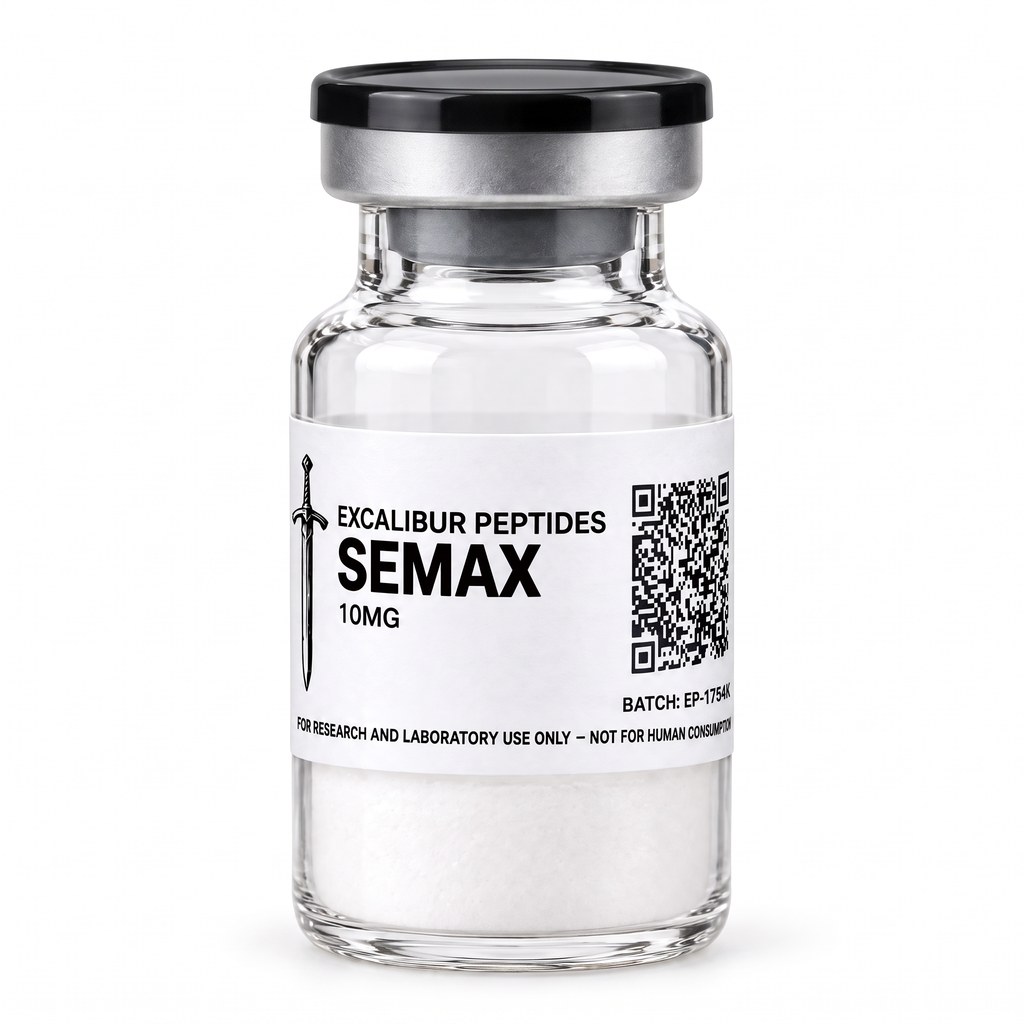
Chemical identity, proposed mechanism and published preclinical literature, for laboratory reference.
Semax is a synthetic heptapeptide derived from the ACTH(4-10) fragment with a C-terminal Pro-Gly-Pro extension that confers resistance to peptidase degradation and removes the corticotropic activity of the parent hormone. Published research has examined its influence on BDNF and NGF expression and their receptor signaling (TrkA/TrkB), on monoaminergic and cholinergic systems, and on neurotrophin-related gene clusters in cortical and hippocampal tissue.
A longer overview of published Semax literature on this ACTH(4-10)-derived heptapeptide, in our 2026 guide.
WARNING: For research and laboratory use only. Not for human consumption. Not approved by the FDA for human use.
Mechanism of Action — Cited Research
Semax is a synthetic heptapeptide derived from the ACTH(4-10) region of adrenocorticotropic hormone: the ACTH(4-7) sequence Met-Glu-His-Phe followed by a Pro-Gly-Pro extension. Published animal research has examined BDNF and TrkB receptor expression in the rat hippocampus following Semax exposure (Dolotov OV et al., Brain Res 2006; PMID: 16996037), and related work has examined NGF and TrkA signaling and neurotrophin-related gene expression in cortical and hippocampal tissue.
Chemical Identity
Semax has the sequence Met-Glu-His-Phe-Pro-Gly-Pro, molecular formula C₃₇H₅₁N₉O₁₀S and molecular weight of about 813.9 g/mol. The C-terminal Pro-Gly-Pro extension confers resistance to peptidase degradation and removes the corticotropic activity of the parent hormone sequence.
Research Context
Semax has been examined in published in-vitro and animal research on neurotrophin signaling (BDNF, NGF and their Trk receptors), monoaminergic systems and gene-expression changes in cortical and hippocampal tissue. Typical experimental systems include cultured neuronal and glial cells, rodent brain tissue analyzed by qPCR, western blotting and transcriptome profiling, and receptor-binding assays.
Analytical Characterization
Purity is assessed by HPLC and identity by LC-MS against the calculated mass of about 814 Da. The N-terminal methionine can oxidize to the sulfoxide (+16 Da), so oxidized variants are monitored as a specific impurity. A Certificate of Analysis is published for this product on our COA page.
Regulatory Status
The Semax supplied by Excalibur Peptides is a research chemical sold strictly for in-vitro laboratory research and identification purposes. It is not approved by the FDA for human or veterinary use and is not intended for human consumption.
Frequently asked questions
What is Semax examined for in research?
Semax is a synthetic ACTH(4-10)-derived heptapeptide examined in published in-vitro and animal research on BDNF and NGF expression, TrkA/TrkB receptor signaling, and monoaminergic systems in cortical and hippocampal tissue.
What is the chemical structure of Semax?
Semax is the heptapeptide Met-Glu-His-Phe-Pro-Gly-Pro (C37H51N9O10S, about 813.9 g/mol). The C-terminal Pro-Gly-Pro extension confers resistance to peptidase degradation and removes the corticotropic activity of the parent ACTH sequence.
Which signaling pathways has Semax been examined in?
Published animal research has examined BDNF and TrkB receptor expression in rat hippocampal tissue, NGF and TrkA signaling, and expression of neurotrophin-related gene clusters in cortical and hippocampal tissue.
How is Semax tested, and where is its COA?
Semax is third-party tested by Freedom Diagnostics Testing: purity by HPLC and identity by LC-MS. The Certificate of Analysis is published in our COA database, and the report can be looked up on the lab's own site with search code Exca2608030568.
Is the Semax sold here approved by the FDA?
No. The Semax sold by Excalibur Peptides is not approved by the FDA for human or veterinary use. It is a research chemical supplied for in-vitro laboratory research and identification purposes only and is not for human consumption.
Where can I buy Semax for research?
Excalibur Peptides sells Semax on this page as a 10mg vial of lyophilized powder, for in-vitro laboratory research only. Orders ship from Austin, Texas, to addresses within the United States, and the product's third-party Certificate of Analysis is published in our COA database. Buyers must be 21 or older and confirm research-use-only status at checkout.
How should Semax be stored in the lab?
Keep lyophilized Semax sealed at −20 °C, protected from light and moisture, as listed on this page. Let the vial reach room temperature before opening so moisture does not condense on the powder, and avoid repeated freeze–thaw cycles.
How fast does Semax ship?
Semax ships from Austin, Texas. Orders placed before 2 PM EST on a business day ship the same day, and delivery within the United States typically takes 2–4 business days. A tracking number is emailed when the order ships.
What payment methods can I use to buy Semax?
We accept credit and debit cards, Apple Pay, Venmo, Cash App and cryptocurrency. Prices are in U.S. dollars.