Metabolic Research · New
5-Amino-1MQ — Research Compound
Small-molecule, membrane-permeable NNMT inhibitor studied for its effects on the NAD+ salvage pathway and nicotinamide N-methylation in preclinical models.
$44.99 · 10mg
Third-party tested · Freedom Diagnostics
View lab-hosted COA · Third-party COA · Lot EP-71184K
- Ships from within the U.S.
- Pay by card, Apple Pay, Venmo, Cash App or crypto
- Stored frozen at −10 °F until ship day
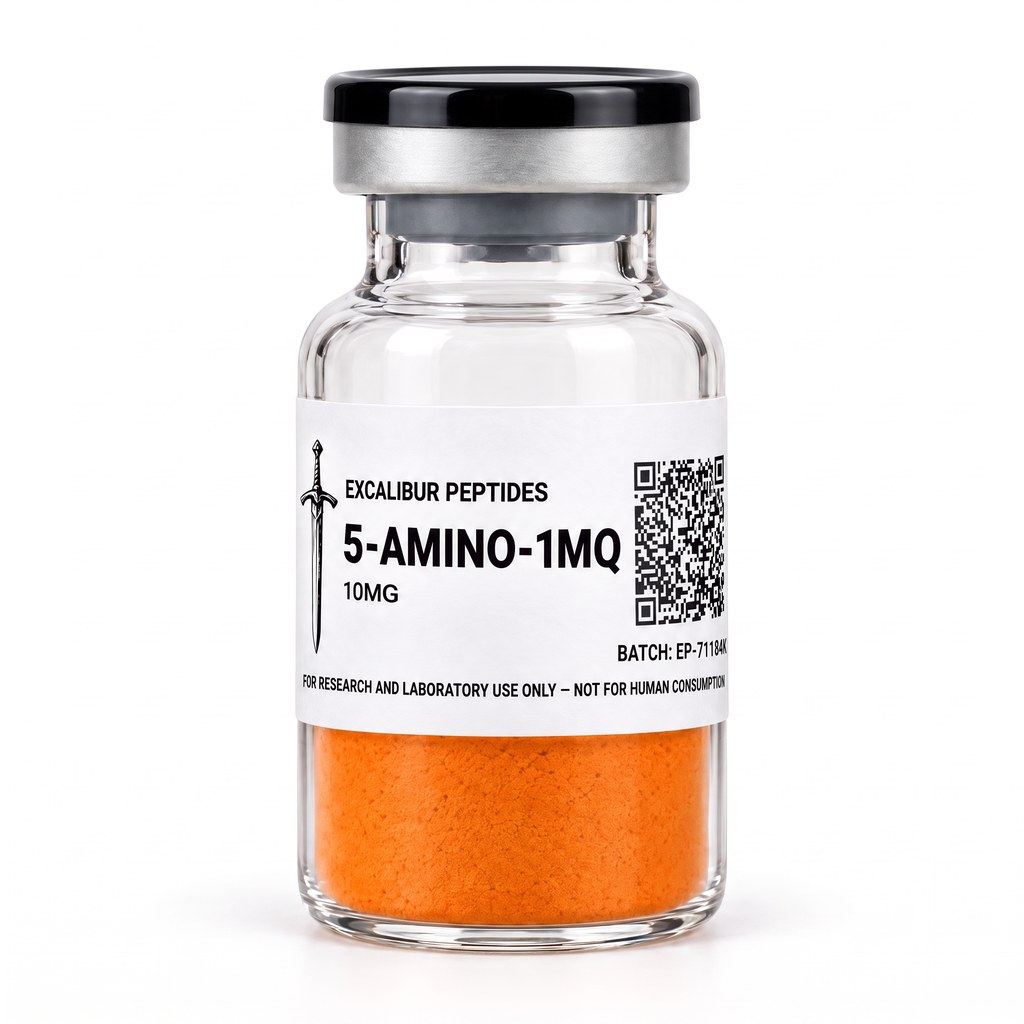
- Batch ID and QR code on the label
For in-vitro laboratory research use only. Not for human consumption.
Specifications
5-Amino-1MQ at a glance.
- Size
- 10mg
- Form
- Lyophilized powder
- Storage
- −20°C (Protected from light and moisture)
- Purity
- 99.85% (HPLC-UV · Freedom Diagnostics COA)
- Molecular weight
- 159.21 g/mol (cation)
- Molecular formula
- C₁₀H₁₁N₂⁺ (quinolinium cation)
- Certificate of Analysis
- Third-party tested (Lot EP-71184K · Freedom Diagnostics)
- Category
- Metabolic Research
- Sequence
- Not applicable (small molecule, non-peptide)
Third-party COA · Lot EP-71184K
Documented by a third-party lab.
Issued and hosted by Freedom Diagnostics Testing, the independent lab that ran it, with Excalibur Peptides as the client. It covers lot EP-71184K. Open the lab-hosted report, or look it up with the search code.
Independent verification
Verify on Freedom Diagnostics.
This 5-Amino-1MQ Certificate of Analysis is hosted on Freedom Diagnostics Testing's own site. Search the code below on the lab's lookup page, or open the lab-hosted PDF. Values are shown as printed on the certificate.
Search code: Exca2609280348
- Lab
- Freedom Diagnostics Testing
- Lot
- EP-71184K
- Sample
- 5-Amino-1MQ 10mg
- Received
- 9/28/2026
- Reported
- 9/29/2026
- Purity (HPLC-UV)
- 99.85%
- Identity (LC-MS)
- Confirmed
- Net content
- 11.22 mg
View lab-hosted COA (PDF on coas.freedomdiagnosticstesting.com)
What's in the box
One vial, part by part.
10mg of 5-Amino-1MQ, supplied as a lyophilized powder in a sealed glass vial.
On the label
Clearly labeled.
Printed label
Product name, size and a research-use-only statement.
Batch ID
A batch number is printed on every label.
QR code
Printed on the label, next to the batch ID.
Research-use line
“For research and laboratory use only — not for human consumption” runs along the bottom of the label.
More in Metabolic Research.
Research
Research background.
Chemical identity, proposed mechanism and published preclinical literature, for laboratory reference.
Mechanism of action
5-Amino-1MQ (5-amino-1-methylquinolinium) is a small-molecule, membrane-permeable inhibitor of nicotinamide N-methyltransferase (NNMT), the cytosolic enzyme that methylates nicotinamide to 1-methylnicotinamide (1-MNA) using S-adenosylmethionine (SAM) as the methyl donor. It is a quinolinium compound, not a peptide. Published preclinical research has examined how NNMT inhibition with 5-Amino-1MQ changes intracellular NAD+, SAM and 1-MNA levels in cultured cells and in mouse models.
Research observations
- Selective NNMT inhibition characterized in enzymatic assays
- Intracellular NAD+, SAM and 1-MNA levels measured in cultured adipocyte models
- Membrane permeability characterized in published cell-based studies
- Structure–activity relationships of quinolinium NNMT inhibitors reported in the literature
- Permanently charged quinolinium cation (C₁₀H₁₁N₂⁺), not a peptide
Key research & publications
- Neelakantan et al. (2017) — Structure–activity relationship study of quinolinium-based NNMT inhibitors that identified low-micromolar analogs, including 5-amino-1-methylquinolinium.
- Neelakantan et al. (2018) — Examined 5-Amino-1MQ in cultured adipocytes and mouse models, measuring intracellular NAD+, SAM and 1-MNA levels.
- Neelakantan et al. (2019) — Examined NNMT inhibition and stem-cell signaling in aged mouse tissue models.
Frequently asked questions.
What is 5-Amino-1MQ?
5-Amino-1MQ (5-amino-1-methylquinolinium) is a small-molecule, membrane-permeable inhibitor of the enzyme nicotinamide N-methyltransferase (NNMT). It is a quinolinium compound, not a peptide. Published preclinical research has measured intracellular NAD+, SAM and 1-MNA levels in cultured cells and mouse models after NNMT inhibition.
Where can I buy 5-Amino-1MQ for research?
Excalibur Peptides sells 5-Amino-1MQ on this page as a 10mg vial of lyophilized powder, for in-vitro laboratory research only. Orders ship from Austin, Texas, to addresses within the United States, and the product's third-party Certificate of Analysis is published in our COA database. Buyers must be 21 or older and confirm research-use-only status at checkout.
How is 5-Amino-1MQ tested, and where is its COA?
5-Amino-1MQ is third-party tested by Freedom Diagnostics Testing: purity by HPLC and identity by LC-MS. The Certificate of Analysis is published in our COA database, and the report can be looked up on the lab's own site with search code Exca2609280348.
How should 5-Amino-1MQ be stored in the lab?
Keep lyophilized 5-Amino-1MQ sealed at −20 °C, protected from light and moisture, as listed on this page. Let the vial reach room temperature before opening so moisture does not condense on the powder, and avoid repeated freeze–thaw cycles.
How fast does 5-Amino-1MQ ship?
5-Amino-1MQ ships from Austin, Texas. Orders placed before 2 PM EST on a business day ship the same day, and delivery within the United States typically takes 2–4 business days. A tracking number is emailed when the order ships.
What payment methods can I use to buy 5-Amino-1MQ?
We accept credit and debit cards, Apple Pay, Venmo, Cash App and cryptocurrency. Prices are in U.S. dollars.
Is 5-Amino-1MQ approved by the FDA?
No. The 5-Amino-1MQ supplied by Excalibur Peptides is not approved by the FDA for human or veterinary use. It is sold only for in-vitro laboratory research and identification purposes and is not for human consumption.
For research and laboratory use only. Not for human consumption.
All products sold on this website are intended for in-vitro laboratory research and identification purposes only. They are not for human or veterinary use and are not for human consumption.
All information is provided for educational and research purposes. Excalibur Peptides does not condone or promote the use of any product for any purpose other than legitimate scientific research and compound identification.