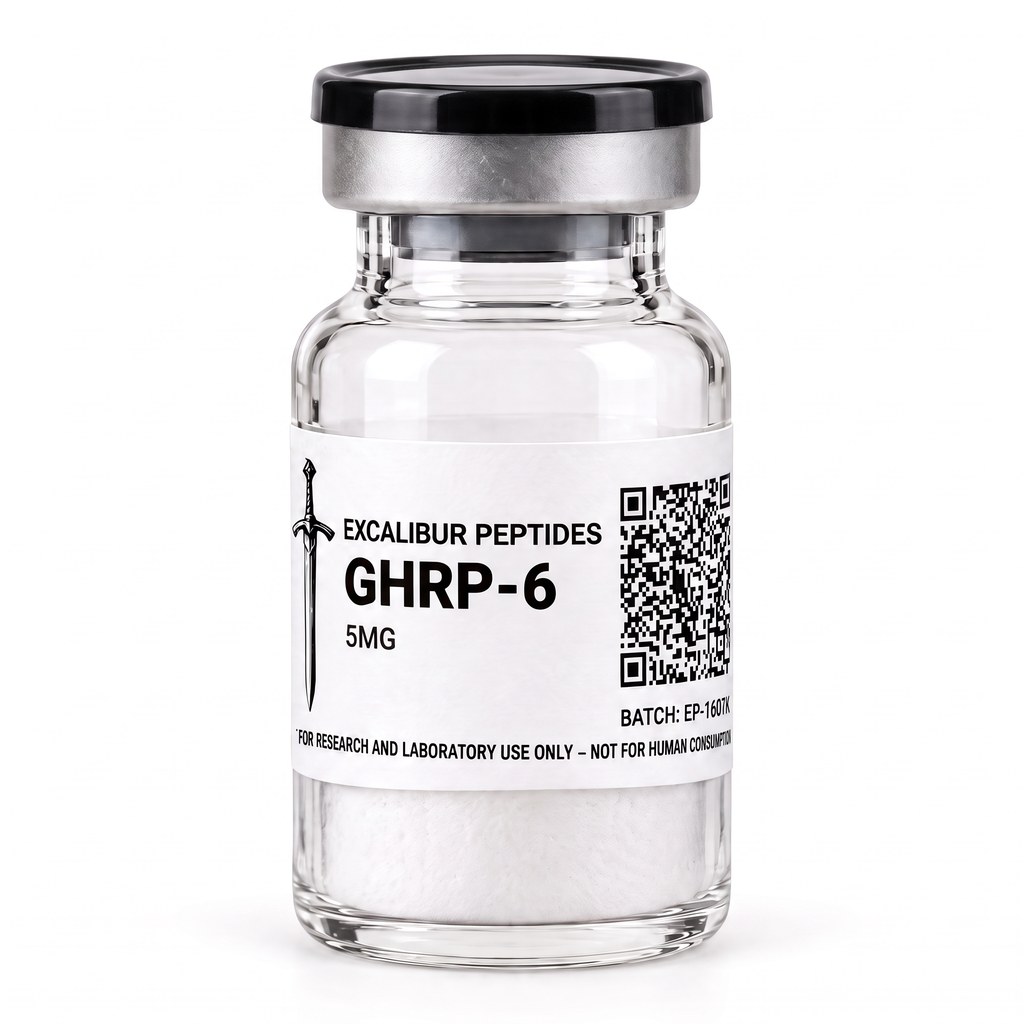
Overview
GHRP-6 (Growth Hormone Releasing Peptide-6) is a synthetic hexapeptide first developed through research into enkephalin analogs in the 1980s by Cyril Bowers and colleagues. It was among the first synthetic growth hormone secretagogues characterized in the literature. GHRP-6 acts as an agonist at the ghrelin receptor (GHS-R1a), which links it to the wider ghrelin receptor signaling system as well as to pituitary somatotroph biology. It has been examined in published in-vitro and animal research and is used as a reference ligand in GHS-R1a pharmacology. For research use only.
Molecular Profile
| Property | Value |
|---|---|
| Full name | Growth Hormone Releasing Peptide-6 |
| Abbreviation | GHRP-6 |
| Peptide sequence | His-D-Trp-Ala-Trp-D-Phe-Lys-NH₂ |
| Molecular weight | ~873 Da |
| CAS | 87616-84-0 |
| Type | Synthetic hexapeptide; GH secretagogue |
| Primary receptor target | GHS-R1a (ghrelin receptor) |
| Secondary receptor | GHS-R1b |
| D-amino acids | D-Trp (pos. 2), D-Phe (pos. 5) — confer proteolytic resistance |
| C-terminus | Lys-NH₂ (amidated) — required for GHS-R1a binding affinity |
Section 1 — Peptide Chemistry & Synthesis
GHRP-6 is a synthetic hexapeptide. Peptides of this kind are generally assembled by Fmoc solid-phase peptide synthesis (SPPS), and two structural features of GHRP-6 require special handling in that chemistry:
D-amino acids (D-Trp at position 2, D-Phe at position 5): Incorporated using the same Fmoc chemistry as L-residues but requiring racemization-free coupling conditions. D-amino acid incorporation confers resistance to proteolytic degradation by peptidases that preferentially cleave L-residue sequences.
C-terminal amide (Lys-NH₂): Achieved by using Rink amide resin, which releases the peptide with an amide rather than a free carboxylic acid upon TFA cleavage. This C-terminal amidation is documented as required for GHS-R1a binding affinity in structure-activity studies of the GHRP class.
Purification: Preparative HPLC is the usual purification method for peptides of this size. The molecular weight of ~873 Da allows straightforward LC-MS identity confirmation — [M+H]⁺ and multiply-charged species are well-resolved under standard ESI-MS conditions.
Storage: Lyophilized white to off-white powder. Store at −20 °C, sealed and protected from light and moisture, as listed on the product page. A Certificate of Analysis reporting HPLC purity and identity is published for this product.
Section 2 — Research Mechanisms
2.1 GHS-R1a Receptor Binding and Ghrelin Pathway Activation
The growth hormone secretagogue receptor type 1a (GHS-R1a) is the endogenous receptor for ghrelin and the molecular target of GHRP-6. It is a seven-transmembrane G-protein-coupled receptor that signals predominantly through Gαq/11, coupling ligand binding to activation of phospholipase Cβ, hydrolysis of phosphatidylinositol-4,5-bisphosphate (PIP2), and the generation of inositol-1,4,5-trisphosphate (IP3) and diacylglycerol (DAG) as intracellular second messengers. IP3-mediated calcium mobilization from endoplasmic reticulum stores, together with DAG-driven activation of protein kinase C, triggers the somatotroph exocytotic machinery. GHRP-6 reproduces the second-messenger cascade triggered by endogenous ghrelin, and concentration-dependent phosphoinositide turnover and GH secretion have been examined in human pituitary somatotroph cell cultures, establishing GHRP-6 as a high-affinity GHS-R1a agonist with a well-characterized cellular pharmacology (Lei et al., 1995; PMID 7772238). This Gq-coupled signaling mode is mechanistically distinct from the Gs/cAMP/PKA cascade engaged by the GHRH receptor on the same somatotrophs.
2.2 Convergence with GHRH Receptor Signaling
GHRH acts via Gαs / adenylyl cyclase / cAMP / PKA, while GHRP-6 acts via Gαq / phospholipase C / IP3-DAG / PKC — two distinct intracellular cascades that converge on the same pool of GH secretory granules but engage different upstream regulatory nodes. In pituitary cell and animal systems, simultaneous activation of both receptors produces greater-than-additive secretory responses, which has made paired GHRH-R and GHS-R1a agonists a standard tool for studying receptor cross-talk at the somatotroph. The apparent potency of GHRP-6 in a given experimental system therefore depends partly on background GHRH and somatostatin signaling, and well-designed studies either standardize or measure these variables.
2.3 Peripheral GHS-R1a Signaling
GHS-R1a expression is not limited to the pituitary somatotroph compartment. The receptor is also found in the gastrointestinal tract, vagal afferent neurons, heart, liver and adipose tissue, and published animal research has examined GHRP-6 as a GHS-R1a agonist in these peripheral tissues. In such studies, investigators use pituitary-independent systems and GHS-R1a antagonist or knockout controls to separate direct peripheral receptor signaling from effects mediated through the pituitary.
Section 3 — Receptor Biology: GHS-R1a
3.1 GHS-R1a Tissue Distribution
GHS-R1a expression is not limited to the pituitary. Tissue distribution studies in human and animal tissue document GHS-R1a mRNA and protein across multiple organ systems (Gnanapavan S et al., J Clin Endocrinol Metab 2002; PMID 12050285):
- Anterior pituitary (somatotrophs): Primary site for GH-secretory signaling
- Hypothalamus (arcuate nucleus, ventromedial nucleus): CNS receptor signaling research
- Hippocampus and limbic regions: Neuroendocrine receptor expression research beyond the pituitary
- Vagus nerve and gastrointestinal tract: Endogenous ghrelin is produced primarily in gastric X/A-like cells; GHS-R1a on vagal afferents has been examined in gut–brain signaling research, and receptor expression has been described in the stomach fundus and small intestine
- Heart, liver, adipose tissue: GHS-R1a expression described in peripheral tissue expression studies
The broad tissue distribution of GHS-R1a means researchers should account for receptor engagement at extrapituitary sites when interpreting GHRP-6 data from systemic animal models.
3.2 GHS-R1a Constitutive Activity
GHS-R1a is unusual among GPCRs for its exceptionally high constitutive (ligand-independent) activity — approximately 50% of maximal IP3 turnover is observed in the absence of any ligand (Holst B et al., J Biol Chem 2004; PMID 15383539). GHRP-6 is a full agonist that elevates GHS-R1a signaling above this constitutive baseline. Researchers studying GHRP-6 pharmacology in heterologous expression systems should note that the high constitutive activity creates a substantial baseline signal that may compress the apparent stimulation window relative to receptor-negative control cells. Inverse agonists that suppress constitutive signaling are useful tools for defining this baseline.
3.3 GHRH-R / GHS-R1a Receptor Cross-Talk
The greater-than-additive response to combined GHRH-R and GHS-R1a activation exceeds what receptor-independent additive models predict, suggesting functional receptor cross-talk or convergent signaling amplification at the somatotroph. Proposed mechanisms include functional interaction between GHRH-R and GHS-R1a signaling complexes — potentially via receptor dimerization or shared downstream effectors, including IP3-mediated calcium synergy with cAMP/PKA pathways. Definitive dimerization evidence requires further characterization; this is presented as a proposed mechanistic framework consistent with published pharmacological data.
Section 4 — Stability Features
| Feature | Description |
|---|---|
| D-amino acid residues | D-Trp and D-Phe confer resistance to endopeptidases targeting L-residue sequences |
| C-terminal amide | Lys-NH₂ protects against carboxypeptidase cleavage from the C-terminus |
| Tryptophan content | Two Trp residues are susceptible to oxidation under light and air exposure |
| Laboratory storage | −20 °C, sealed and protected from light and moisture, as listed on the product page |
Section 5 — Comparative Pharmacology
| Compound | Receptor | Structure | Research Note |
|---|---|---|---|
| GHRP-6 | GHS-R1a | Hexapeptide His-D-Trp-Ala-Trp-D-Phe-Lys-NH₂ | Broad ghrelin-receptor reference ligand |
| Ipamorelin | GHS-R1a | Pentapeptide Aib-His-D-2-Nal-D-Phe-Lys-NH₂ | Selective GHS-R1a agonist in animal studies (PMID 9849822) |
| Hexarelin | GHS-R1a | Hexapeptide with 2-methyl-D-Trp at position 2 | Close structural analog of GHRP-6 |
| GHRP-2 | GHS-R1a | Hexapeptide D-Ala-D-2-Nal-Ala-Trp-D-Phe-Lys-NH₂ | Structural analog used in GHRP structure–activity comparisons |
| Sermorelin | GHRH-R | GHRH(1-29)-NH₂ | GHRH receptor pathway |
| Tesamorelin | GHRH-R | GHRH(1-44) with N-terminal trans-3-hexenoyl group | GHRH receptor pathway |
GHRP-6 vs Ipamorelin
Ipamorelin and GHRP-6 share the same molecular target — GHS-R1a — but differ in structure and selectivity. Ipamorelin was characterized in animal models as a highly selective GHS-R1a agonist that released GH without the ACTH and cortisol elevation seen with GHRP-6 (Raun K et al., 1998; PMID 9849822). GHRP-6, by contrast, engages a broader ghrelin-receptor signaling profile. The choice between the two in research design depends on intent: ipamorelin when a narrowly selective GHS-R1a probe is needed, and GHRP-6 when the broader ghrelin-receptor system is itself the subject of study.
GHRP-6 vs GHRP-2
GHRP-2 is structurally related to GHRP-6, replacing His-D-Trp at the N-terminus with D-Ala-D-2-naphthylalanine, and acts at the same GHS-R1a receptor. For structure–activity research, the pair illustrates how N-terminal aromatic and D-residue substitutions change receptor interaction while preserving the conserved Trp-D-Phe-Lys-NH₂ C-terminal motif.
GHRP-6 vs Hexarelin
Hexarelin differs from GHRP-6 only by a methyl group on the D-tryptophan at position 2. This single modification alters receptor interaction and has made the pair a classic example in GHRP structure–activity research. Hexarelin has also been reported to bind CD36 in addition to GHS-R1a, which is relevant when interpreting data from tissues that express CD36.
GHRP-6 vs Tesamorelin (GHRH-R Class)
GHRP-6 and Tesamorelin engage entirely different receptor classes — GHS-R1a versus GHRH-R — and signal through complementary intracellular cascades (Gq/PLC/PKC versus Gs/cAMP/PKA respectively). The two compounds are therefore not interchangeable in receptor-specific pharmacology, but they are studied together in research on receptor cross-talk at the somatotroph, where simultaneous activation of both receptors produces greater-than-additive signaling.
Practical Selection Summary
In summary: choose GHRP-6 when a broad ghrelin-receptor reference ligand is required; ipamorelin when narrowly selective GHS-R1a probing is required; GHRP-2 or hexarelin for structure–activity comparisons within the GHRP family; and tesamorelin or other GHRH-R analogs when the upstream GHRH receptor — rather than the ghrelin receptor — is the experimental target.
Section 6 — Research Contexts
GHS-R1a Receptor Pharmacology
GHRP-6 is one of the most thoroughly characterized GHS-R1a ligands and serves as a reference agonist in radioligand binding, calcium flux, IP1 accumulation and reporter-gene assays. It is frequently used to benchmark new ghrelin-receptor agonists, antagonists and inverse agonists.
Second-Messenger Signaling
Because GHS-R1a couples mainly to Gαq/11, GHRP-6 is used to study phospholipase C activation, IP3-mediated calcium release and PKC signaling in receptor-expressing cells, and to compare these responses with the Gαs/cAMP pathway activated by GHRH-R agonists in the same cells.
Somatotroph Cell Biology
Primary pituitary cell cultures and perifused pituitary preparations are used to study how GHRP-6 influences GH secretory granule exocytosis and how this interacts with GHRH-R and somatostatin receptor signaling.
Receptor Cross-Talk and Dimerization
Paired use of GHRP-6 and GHRH-R agonists in cell systems supports research into the mechanisms behind greater-than-additive somatotroph signaling, including proposed GHS-R1a/GHRH-R interaction and shared downstream effectors.
Constitutive Activity Research
The high ligand-independent activity of GHS-R1a makes it a model receptor for studying constitutive GPCR signaling. GHRP-6 is used alongside inverse agonists to define the full range of receptor activity states.
Receptor Distribution Research
GHS-R1a expression in hypothalamic, limbic and brainstem regions and in peripheral tissues (PMID 12050285) supports research into ghrelin-receptor signaling outside the pituitary, using GHRP-6 as a stable synthetic agonist.
Analytical Reference Standard Use
As a well-defined hexapeptide containing two D-residues and two tryptophans, GHRP-6 is also used as a reference standard in HPLC and LC-MS method development, including separation of diastereomers and oxidized tryptophan variants.
Section 7 — In-Vitro Methodology Considerations
- Solution chemistry: GHRP-6 is freely water-soluble. Its D-amino acid residues have improved but not absolute resistance to base-mediated epimerization, so prolonged exposure to strongly alkaline pH can alter the peptide.
- Cell systems: GH3 and MMQ pituitary cell lines express endogenous GHS-R1a and are used for receptor pharmacology; HEK293 cells transfected with GHS-R1a are used for binding studies. Confirm GHS-R1a expression by qPCR or western blot before functional assays.
- Assay readouts: Calcium flux (fluorescent dyes or aequorin), IP1 accumulation (HTRF) and NFAT-driven reporter genes are standard Gαq readouts. GH released from primary pituitary cells is measured by immunoassay.
- Constitutive activity: Include receptor-negative parental cells and an inverse agonist control to define baseline signaling in GHS-R1a-expressing lines.
- Serum effects: Serum contains ghrelin and proteases; serum-free stimulation buffers give more interpretable concentration–response data.
- Concentration–response design: Run curves spanning several log units in replicate so that EC50 values can be compared between ligands.
Section 8 — Analytical Characterization
GHRP-6 purity is assessed by HPLC with UV detection, and identity by LC-MS (electrospray mass spectrometry) against the calculated mass of about 873 Da. Two impurity classes deserve particular attention. First, epimerization at the D-Trp or D-Phe positions during synthesis produces diastereomers with the same mass as the target peptide; these are resolved chromatographically or assessed by chiral amino acid analysis. Second, oxidation of either tryptophan residue produces +16 Da and +32 Da variants, which are monitored by LC-MS. A Certificate of Analysis is published for this product.
Citations
- Lei T et al. J Mol Endocrinol 1995;14(1):135. PMID 7772238
- Holst B et al. J Biol Chem 2004. PMID 15383539
- Gnanapavan S et al. J Clin Endocrinol Metab 2002. PMID 12050285
- Raun K et al. Ipamorelin, the first selective growth hormone secretagogue. Eur J Endocrinol 1998. PMID 9849822
- Howard AD et al. Science 1996 (cloning of GHS-R1a)
- Kojima M et al. Nature 1999 (identification of ghrelin)
Explore our full research peptide catalog or view the Certificate of Analysis published for this product.
Section 9 — Research Outlook and Cross-Reference
GHRP-6 occupies a distinct niche in research peptide pharmacology as one of the most thoroughly characterized broad-spectrum GHS-R1a agonists. Unlike the more selective ipamorelin, GHRP-6 engages the wider ghrelin-receptor signaling system, which makes it a useful probe in research designs that treat ghrelin-receptor biology as an integrated system rather than isolating a single downstream pathway. The compound is most informative when used with appropriate controls — receptor-negative cells, inverse agonists, and measurement of GHRH-R and somatostatin receptor signaling where these are present in the cell system.
For investigators integrating GHRP-6 into broader GH-axis receptor research, the most informative comparator compound is Tesamorelin, a full-length GHRH analog that acts at the GHRH receptor and complements GHRP-6 in research on GHRH-R / GHS-R1a cross-talk. BPC-157 is a separate 15-residue research peptide with an unrelated molecular focus, listed here for catalog reference.
Internal references: Tesamorelin (GHRH-R class — complementary receptor for GHRH-R / GHS-R1a cross-talk research) · BPC-157 (15-residue synthetic research peptide)
WARNING: For research and laboratory use only. Not for human consumption. Not approved by the FDA for human use.